
Gap-Free Tunable Femtosecond OPO
A fully-automated femtosecond optical parametric oscillator (OPO) that offers gap-free wavelength coverage across the UV, Visible and IR with no change of optics or crystals and just one single configuration.
The Inspire advanced control software ensures fast and reliable tuning while providing a selection of practical operating features.


Description
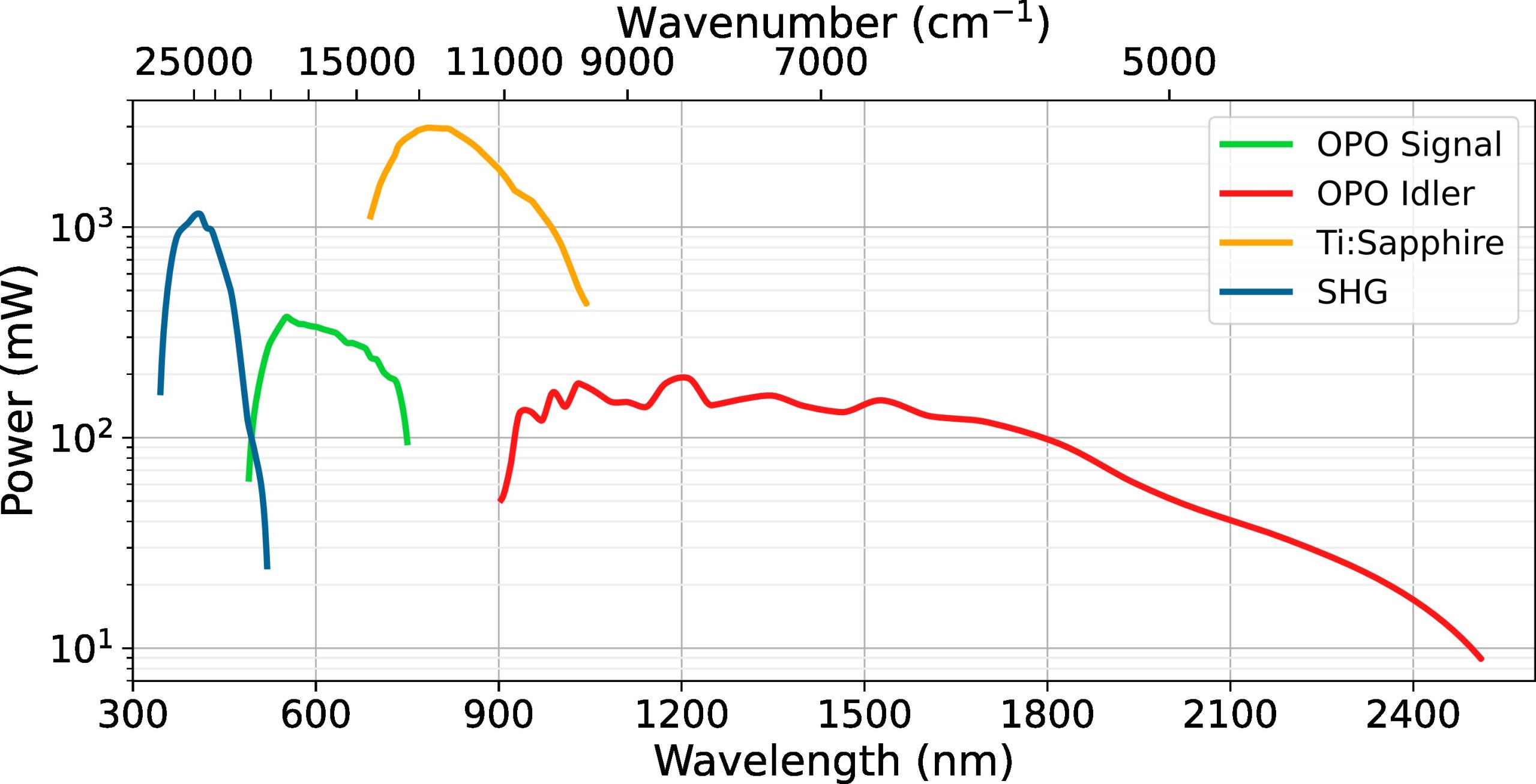
The Inspire is a femtosecond OPO, pumped by a mode-locked Ti:Sapphire oscillator, which offers the broadest tunability in the UV, Visible and IR, across 345 – 2500 nm. Four separate output ports emitting the doubled pump [345 – 540 nm], signal [490 – 750 nm], depleted-pump [680 – 1080 nm], and idler [930 – 2500 nm] are available.
Selection between the simultaneous signal and idler outputs (tunable across the range at a fixed pump wavelength), or the simultaneous doubled and depleted-pump outputs (tunable across the range while tuning the pump laser) is straightforward through the fully-automated control software.
Several Inspire models are available which provide different characteristics of automation and spectral coverage, as detailed in the specification table.
Key Features
Gap-Free Tuning
Gap-free tuning across the UV, Visible and IR [345 – 2500 nm (4000 – 28985 cm-1)] with a single configuration and without any change of optics
Fully Automated
Fully-automated computer-controlled tuning and self-calibration
Simultaneous Beams
Simultaneous UV, Visible and IR beams available through 3 separate output ports
Integrated SHG
Integrated Second Harmonic Generation Unit for doubling the un-depleted pump
Ultrashort Pulses
Ultrashort pulses (typ. 180 fs) at 80 MHz
Ti:Sapphire Pumped
Pumped by a mode-locked Ti:Sapphire oscillator for the broadest tunability
| Specification | Value |
|---|---|
| SHG average power @ 400 nm1 | 1100 mW |
| Signal average power @ 550 nm2 | 350 mW |
| Depleted fundamental average power @ 800 nm3 | 1100 mW |
| Idler average power4 | 170 mW |
| SHG pulse width5 | <140 fs |
| Signal pulse width | 100–250 fs (Auto) / 200 fs (HF) |
| Depleted fundamental pulse width | <140 fs |
| Idler pulse width | 80–250 fs (Auto) / 200 fs (HF) |
| SHG tuning range6 | 345 – 520 nm (19230 – 28985 cm⁻¹) |
| Signal tuning range7 | 490 – 750 nm (13333 – 20408 cm⁻¹) |
| Depleted fundamental tuning range8 | 690 – 1040 nm (9615 – 14492 cm⁻¹) |
| Idler tuning range9 | 930 – 2500 nm (4000 – 10752 cm⁻¹) |
| Repetition rate | 80 MHz |
| Noise | <1% rms |
| Wavelength stability @ 555 nm | <0.5 nm |
| Polarization | Horizontal (signal/idler), Vertical (SHG) |
| Spectrometer (UV–Vis)10 | 350 – 900 nm (11111 – 28571 cm⁻¹) |
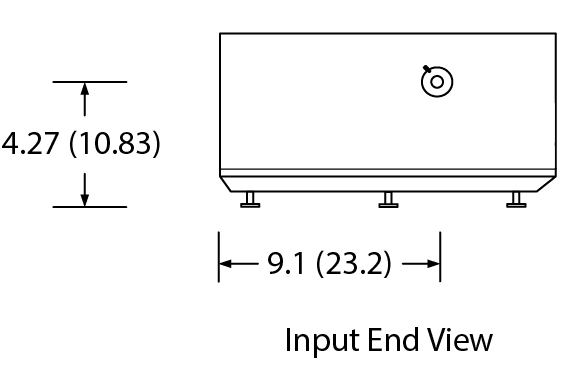
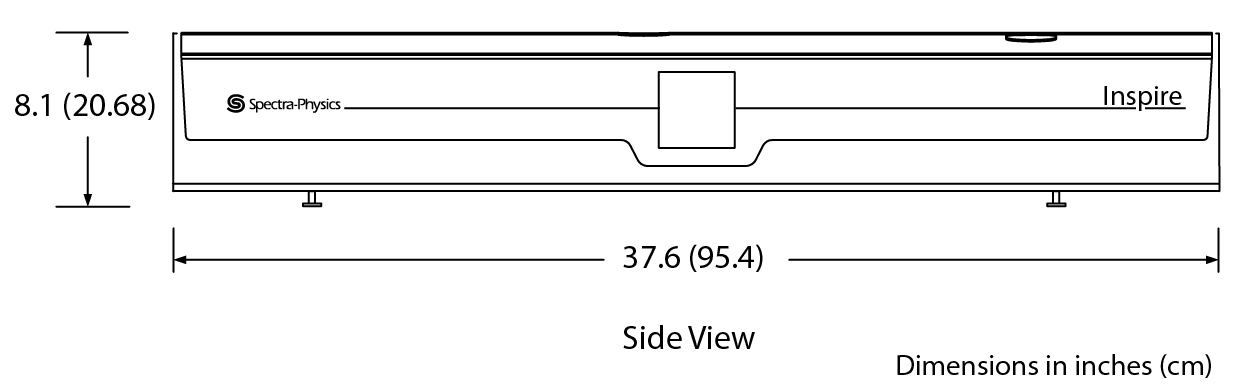
| Dimensions (W x L x H)11 | 36.0 x 95.4 x 23.2 cm (14.2 x 37.6 x 9.1 in) |
1 Auto 100 & HF 100 only
2 All models
3 All models
4 All models
5 100 models only
6 100 models only
7 All models
8 All models
9 All models
10 Integrated into optics unit
11 PC controllable
Performance Charts

Dimensions

Models
Inspire HF 100
Tuning range
Signal wavelength: 490 – 750 nm
Idler wavelength: 990 – 2500 nm
Pump wavelength: 690 – 1040 nm
SHG wavelength: 345 – 520 nm
Average power
Signal average power: 350 mW
Idler average power: 170 mW
Pump average power: 1100 mW
Pulse duration: Femtosecond Integrated pump: No
Inspire Auto 100
Tuning range
Signal wavelength: 490 – 750 nm
Idler wavelength: 990 – 2500 nm
Pump wavelength: 690 – 1040 nm
SHG wavelength: 345 – 520 nm
Average power
Signal average power: 350 mW
Idler average power: 170 mW
Pump average power: 1100 mW
Pulse duration: Femtosecond Integrated pump: No
Inspire HF 50
Tuning range
Signal wavelength: 490 – 750 nm
Idler wavelength: 990 – 2500 nm
Pump wavelength: 690 – 1040 nm
SHG wavelength: n/a
Average power
Signal average power: 350 mW
Idler average power: 170 mW
Pump average power: 1100 mW
Pulse duration: Femtosecond Integrated pump: No
Inspire Auto 50
Tuning range
Signal wavelength: 490 – 750 nm
Idler wavelength: 990 – 2500 nm
Pump wavelength: 690 – 1040 nm
SHG wavelength: n/a
Average power
Signal average power: 350 mW
Idler average power: 170 mW
Pump average power: 1100 mW
Pulse duration: Femtosecond Integrated pump: No
Applications




Scientific Papers

A tunable transition metal dichalcogenide entangled photon-p...
Entangled photon-pair sources are at the core of quantum applications like quantum key distribution, sensing, a......
Fast optoelectronic charge state conversion of silicon vacan...
Group IV vacancy color centers in diamond are promising spin-photon interfaces with strong potential for applic......
Enhanced Nonlinearity of Epsilon-Near-Zero Indium Tin Oxide ...
Recently, materials with vanishingly small permittivity, known as epsilon-near-zero (ENZ) media, emerged as pro......
Three-Photon Excitation of InGaN Quantum Dots
We demonstrate that semiconductor quantum dots can be excited efficiently in a resonant three-photon process, w......
Consistent pattern printing of the gap structure in femtosec...
Maskless lithography technologies have been developed and played an important role in the fabrication of functi......
Structure-dependent optical nonlinearity of indium tin oxide
We use post-deposition vacuum annealing of epsilon-near-zero (ENZ) indium tin oxide (ITO) nanolayers in order t......
Subwavelength-scale lasing perovskite with ultrahigh Purcell...
The capability to control light-matter interfaces creates enormous opportunities across a wide spectrum of phot......
Li@C60 thin films: characterization and nonlinear optical pr...
A facile way is shown to obtain thin films of Li@C 60 as well as their characterization and nonlinear optical p......
Ultrafast Electron Cooling and Decay in Monolayer WS2 Reveal...
by time- and energy-resolved photoemission electron microscopy (PEEM). Electron cooling in the Q valley of the ......
Quantum electrodynamics at room temperature coupling a singl...
Interactions between a single emitter and cavity provide the archetypical system for fundamental quantum elect......
Chiral selection rules for multi-photon processes in two dim...
We examine the chirality-dependent optical selection rules in two-dimensional monolayer materials with honeycom......
Impact of environment on dynamics of exciton complexes in a ...
Scientific curiosity to uncover original optical properties and functionalities of atomically thin semiconducto......
Pulsed Molecular Optomechanics in Plasmonic Nanocavities: Fr...
New experiments on molecules trapped in an ultrasmall optical cavity reveal details of how molecular bonds inte......
Background-Free 3D Nanometric Localization and Sub-nm Asymme...
Despite many advances, rapid, precise 3D tracking of nanoscale particles in a complex environment remains chall......
Structural phase transition in monolayer MoTe2 driven by ele...
Read paper in full ...
Nonlinear optical selection rule based on valley-exciton loc...
Optical selection rules fundamentally determine the optical transitions between energy states in a variety of p......
Enhanced photoluminescence of Si nanocrystals-doped cellulos...
We report the development of bio-compatible cellulose nanofibers doped with light emitting silicon nanocrystals......
Quantitative measurement of graphitic sp2 on single nanodiam...
Read paper in full ...
Accelerated molecular vibrational decay and suppressed elect...
Molecular vibrations and their dynamics are of outstanding importance for electronic and thermal transport in n......
Femtosecond laser-induced fluorescence spectroscopy for the ...
Read paper in full ...
Chirality conferral enables the observation of hyper-Raman o...
Chirality conferral is fundamental for understanding the origin of life, and it is of direct importance for syn......
Spatially inhomogeneous inverse Faraday effect provides tuna...
We demonstrate optical nonthermal excitation of exchange dominated spin waves of different orders in a magnetop......
Nonlinear dispersion relation and out-of-plane second harmon...
Janus transition metal dichalcogenides are an emerging class of atomically thin materials with engineered broke......
Giant optomechanical spring effect in plasmonic nano- and pi...
Molecular vibrations couple to visible light only weakly, have small mutual interactions, and hence are often i......
Near-field terahertz nonlinear optics with blue light
The coupling of terahertz optical techniques to scattering-type scanning near-field microscopy (s-SNOM) has rec......
Semitransparent Organic Photovoltaics Utilizing Intrinsic Ch...
In organic semiconductors, a donor/acceptor heterojunction is typically required for efficient dissociation of ......
Photocyclization reaction and related photodynamics in the p...
. We also demonstrate that the kinetics of the bulky TTECOOBu is much slower than that of the TPE core. Our res......
Interrogating the Behaviour of a Styryl Dye Interacting with...
In this contribution, we report on the solid-state-photodynamical properties and further applications of a low ......
Anomalous deep-red luminescence of perylene black analogues ...
...
Photophysics of Defect-Passivated Quasi-2D (PEA)2PbBr4 Perov...
2D Ruddlesden–Popper perovskites are promising candidates for energy-harvesting applications because of their......
Ultraviolet/Visible Quasicylindrical Waves on Semimetal Cd3A...
Resolving the photonic modes in real space is essential to understand the fundamental process and control of ph......
Coherent dynamics of a single Mn-doped quantum dot revealed ...
For future quantum technologies the combination of a long quantum state lifetime and an efficient interface wit......
Optical Activity in Third-Harmonic Rayleigh Scattering: A Ne...
In 3D isotropic liquids, optical third‐harmonic generation is forbidden, with circularly polarized light (CPL......
Intrinsic efficiency limits in low-bandgap non-fullerene acc...
In bulk heterojunction (BHJ) organic solar cells (OSCs) both the electron affinity (EA) and ionization energy (......
Two-Photon-Induced [2 + 2] Cycloaddition of Bis-thymines
Despite having great value across a wide variety of scientific fields, two-photon polymerizations currently suf......
Ultrafast and Long-Range Exciton Migration through Anisotrop...
The exciton migration mechanism in organic photovoltaic devices is still an ambiguity owing to the insufficient......
Relaxation and transfer of photoexcited electrons at a copla...
Fundamental dynamic processes at the electronic contact interface, such as carrier injection and transport, be......
Enhancing the Charge Extraction and Stability of Perovskite ...
Charge transport layers strongly influence the performance of perovskite solar cells (PSCs). To date, compact l......
Giant peak of the Inverse Faraday effect in the band gap of ...
Optical impact on the spin system in a magnetically ordered medium provides a unique possibility for local mani......
Heterodyne dual-polarization epi-detected CARS microscopy fo...
Coherent Raman Scattering (CRS) has emerged in the last decade as a powerful multiphoton microscopy technique o......
Ultrafast fluorescent decay induced by metal-mediated dipole...
Two-dimensional molecular aggregate (2DMA), a thin sheet of strongly interacting dipole molecules self-assemble......
Antireflective photonic structure for coherent nonlinear spe...
This work presents epitaxial growth and optical spectroscopy of CdTe quantum dots (QDs) in (Cd,Zn,Mg)Te barrier......
Conformational Coupling across the Plasma Membrane in Activa...
Summary How the epidermal growth factor receptor (EGFR) activates is incompletely understood. The intracellular......
Ultrafast pump-probe photo-induced force microscopy at nanos...
We perform time-resolved pump-probe microscopy measurements by recording the local force between a sharp tip an......
Probing excitonic dark states in single-layer tungsten disul...
Transition metal dichalcogenide (TMDC) monolayers have recently emerged as an important class of two-dimensiona......
Erbium doping of lithium niobate on insulator using low-temp...
We propose an optimized low-temperature ion exchange method for fabricating an erbium-doped lithium niobate on ......
Second harmonic generation in monolithic gallium phosphide m...
Gallium phosphide (GaP) offers unique opportunities for nonlinear and quantum nanophotonics due to its wide opt......
Front-contact passivation through 2D/3D perovskite heterojun...
Read paper in full ...
Spatially engineered nonlinearity in resonant metasurfaces
Spatial engineering of the nonlinear susceptibility χ ( 2 ) in resonant metasurfaces offers a new degree of fr......
Correlative light-electron microscopy using small gold nanop...
Correlative light-electron microscopy (CLEM) requires the availability of robust probes which are visible both ......
Revealing low-loss dielectric near-field modes of hexagonal ...
Low-loss dielectric modes are important features and functional bases of fundamental optical components in on-c......
Simultaneous microscopic imaging of thickness and refractive...
The detection of spatial or temporal variations in very thin samples has\nimportant applications in the biologi......
Visible-wavelength two-photon excitation microscopy with mul...
Two-photon excitation microscopy is one of the key techniques used to observe three-dimensional (3-D) structure......
Preserving the Emission Lifetime and Efficiency of a Monolay...
Monolayer transition metal dichalcogenides (TMDs) are promising semiconductors for nanoscale photonics and opto......
On-chip noninterference angular momentum multiplexing of bro...
A twist on optical multiplexing Information can be encoded using various properties of light. Optical multiplex......
Impact of Cooperativity on the Spatial and Temporal Evolutio...
Spin crossover (SCO) complexes are highly flexible bistable molecular switches with two distinct spin states th......
Related Products


