
Laser Spectroscopy
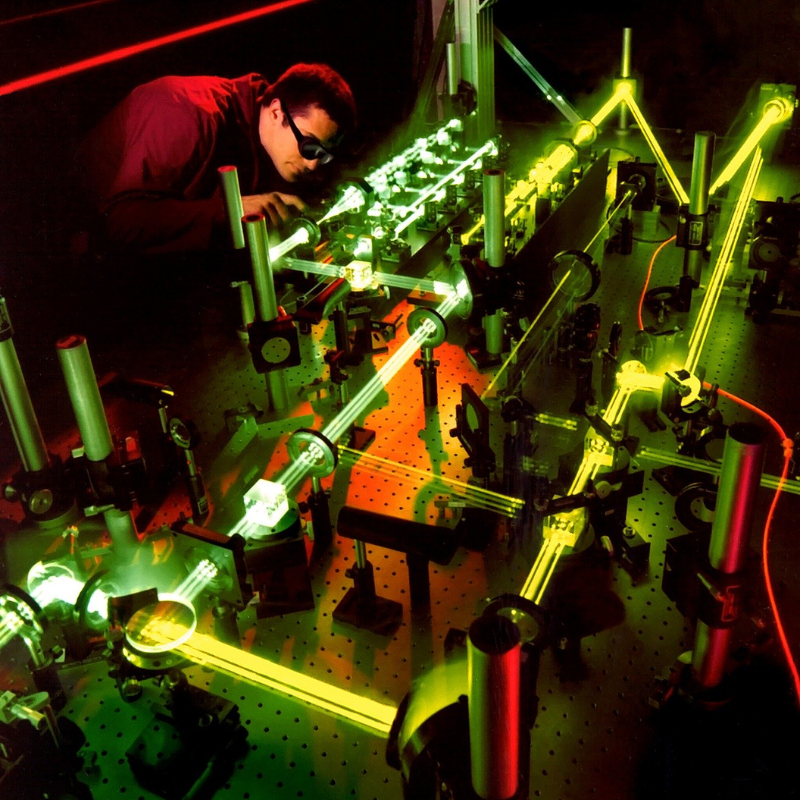
Laser spectroscopy investigates how light interacts with matter to reveal chemical composition, molecular structure, and physical properties. The combination of tunable laser sources and advanced spectroscopic techniques enables highly selective and sensitive measurements across a broad spectral range. Applications span from Raman and vibrational spectroscopy to ultrafast, time-resolved, and high-resolution studies of materials, molecules, and dynamic processes.
Raman Spectroscopy
Raman spectroscopy reveals the vibrational fingerprint of molecules by analyzing the light scattered from a sample. This powerful technique enables non-destructive chemical identification and characterization of materials across chemistry, biology, and materials science. Tunable lasers are particularly valuable for advanced Raman methods such as SRS and CARS, enhancing sensitivity and molecular selectivity.

Pump-Probe and Time-Resolved Spectroscopy
Capturing how materials and molecules evolve after excitation provides unique insight into ultrafast physical, chemical, and biological processes. By following transient states, energy transfer pathways, charge carrier dynamics, and relaxation mechanisms on femtosecond timescales, researchers can uncover fundamental behavior that remains hidden in steady-state measurements. Ultrafast and tunable laser sources enable selective excitation and probing across diverse materials and spectral regions.

Vibrational Spectroscopy
Molecular vibrations provide a unique fingerprint that reveals the composition and structure of matter. By probing these characteristic vibrational modes, researchers can identify molecules, study chemical bonds, and monitor reactions with high specificity. Tunable laser sources in the IR enable selective access to vibrational transitions, supporting applications in chemistry, materials science, environmental analysis, and life sciences.

Non-linear Spectroscopy
When light interacts with matter at high intensities, new optical phenomena emerge that reveal information beyond the reach of conventional measurements. By probing nonlinear light-matter interactions, researchers can investigate molecular structure, material properties, and interfacial dynamics with exceptional sensitivity. These powerful techniques provide unique insight into complex systems, enabling advanced studies in chemistry, materials science, and surface physics.

Fluorescence Spectroscopy
Fluorescence spectroscopy harnesses the light emitted by molecules and materials following optical excitation, providing highly sensitive insight into their composition, structure, and environment. Widely used in chemistry, biology, and materials science, it enables the detection of subtle changes and trace species. Tunable laser sources maximize excitation efficiency and measurement sensitivity across diverse applications.

High Resolution Spectroscopy
High-resolution spectroscopy enables the precise measurement of atomic and molecular transitions, revealing subtle spectral features that are inaccessible with conventional techniques. CW narrow-linewidth laser sources are essential for these applications, providing exceptional frequency stability, spectral purity, and accuracy for precision metrology, fundamental physics, quantum technologies, and advanced molecular characterization.

Interested in tunable lasers for spectroscopy?
Our team can advise on the right broadly tunable laser system for your spectroscopic technique and wavelength range.
Download our systems brochure
Browse our high-performance, broadly tunable laser systems for scientific and industrial applications
Request successful
Check your email for the product catalog
Sorry, the enquiry was not sent
There seems to be an issue with your form submission. Please try again, if this error persists contact sales@radiantis.com
Relevant Resources

Suppressed Stokes Shifts and Hot Luminescence from Quantum D…
Lead sulfide (PbS) quantum dots (QDs) hold great promise for solar energy conversion, yet their efficiency is ……
Accelerated molecular vibrational decay and suppressed elect…
Molecular vibrations and their dynamics are of outstanding importance for electronic and thermal transport in n……
Single Photon multiclock lock-in detection by picosecond tim…
Extracting signals at low single-photon count rates from large backgrounds is a challenge in many optical exper……
Quantum electrodynamics at room temperature coupling a singl…
Interactions between a single emitter and cavity provide the archetypical system for fundamental quantum elect……
Pulsed Molecular Optomechanics in Plasmonic Nanocavities: Fr…
New experiments on molecules trapped in an ultrasmall optical cavity reveal details of how molecular bonds inte……
Picosecond transfer from short-term to long-term memory in a…
Previous experiments in compensated magnets have demonstrated a potential for approaching the limit of fastest ……
Ultrafast Electron Cooling and Decay in Monolayer WS2 Reveal…
by time- and energy-resolved photoemission electron microscopy (PEEM). Electron cooling in the Q valley of the ……
Femtosecond-Laser-Pulse Characterization and Optimization fo…
We present a simple method and its experimental implementation to determine the pulse durations and linear chir……
Stacking Engineering toward Giant Second Harmonic Generation…
The nonlinear optical response in graphene is finding increasing applications in nanophotonic devices. The acti……
A tunable transition metal dichalcogenide entangled photon-p…
Entangled photon-pair sources are at the core of quantum applications like quantum key distribution, sensing, a……
Nonlinear dispersion relation and out-of-plane second harmon…
Janus transition metal dichalcogenides are an emerging class of atomically thin materials with engineered broke……
Near-field terahertz nonlinear optics with blue light
The coupling of terahertz optical techniques to scattering-type scanning near-field microscopy (s-SNOM) has rec……
Transition from Diffusive to Superdiffusive Transport in Car…
The one-dimensional confinement of quasiparticles in individual carbon nanotubes (CNTs) leads to extremely anis……
Three-Photon Excitation of InGaN Quantum Dots
We demonstrate that semiconductor quantum dots can be excited efficiently in a resonant three-photon process, w……
Structure-dependent optical nonlinearity of indium tin oxide
We use post-deposition vacuum annealing of epsilon-near-zero (ENZ) indium tin oxide (ITO) nanolayers in order t……
Efficient Generation of Two-Photon Excited Phosphorescence f…
inside individual plasmonic nanocavities containing emitters sandwiched between a gold nanoparticle and a gold ……
Imaging and tracking single plasmonic nanoparticles in 3D ba…
We present a four-wave mixing interferometry technique recently developed by us, whereby single non-fluorescing……
Coherent dynamics of resonantly excited excitons in monolaye…
We investigate dynamics of resonantly excited excitons in single-layers of MoSe<sub>2</sub> and WS&……
Dynamics of resonantly excited excitons in MoSe2 and WS2 sin…
We investigate dynamics of resonantly excited excitons in single-layers of MoSe$_2$ and WS$_2$ down to 4.5 K. T……
Coherence and Density Dynamics of Excitons in a Single-Layer…
High Resolution Image Download MS PowerPoint Slide We measure the coherent nonlinear response of excitons in a ……
Impact of environment on dynamics of exciton complexes in a …
Scientific curiosity to uncover original optical properties and functionalities of atomically thin semiconducto……
Ultra-broadband enhancement of nonlinear optical processes f…
Broadband light trapping and field localization is highly desired in enhanced light-matter interaction, especia……
Nonlinear optical selection rule based on valley-exciton loc…
Optical selection rules fundamentally determine the optical transitions between energy states in a variety of p……
Probing excitonic dark states in single-layer tungsten disul…
Transition metal dichalcogenide (TMDC) monolayers have recently emerged as an important class of two-dimensiona……
Composition-controlled recovery time of SWIR (2–2.4 µm) G…
SEmiconductor Saturable Absorber Mirrors (SESAMs) have revolutionized the ultrafast laser industry. While SESAM……
Quenching Circuit Discriminator Architecture Impact on a Sub…
In the field of radiation instrumentation, there is a desire to reach a sub-10 ps FWHM timing resolution for ap……
Quenching Circuit and SPAD Integrated in CMOS 65 nm with 7.8…
This paper presents a new quenching circuit (QC) and single photon avalanche diode (SPAD) implemented in TSMC C……
Femtosecond laser-induced fluorescence spectroscopy for the …
Read paper in full …
Subwavelength-scale lasing perovskite with ultrahigh Purcell…
The capability to control light-matter interfaces creates enormous opportunities across a wide spectrum of phot……
Homo-FRET Based Biosensors and Their Application to Multiple…
Multiplexed imaging of Förster Resonance Energy Transfer (FRET)-based biosensors potentially presents a powerf……
Quantitative measurement of graphitic sp2 on single nanodiam…
Read paper in full …
Chirality conferral enables the observation of hyper-Raman o…
Chirality conferral is fundamental for understanding the origin of life, and it is of direct importance for syn……
Optical Activity in Third-Harmonic Rayleigh Scattering: A Ne…
In 3D isotropic liquids, optical third‐harmonic generation is forbidden, with circularly polarized light (CPL……
Quantitative Label-Free Imaging of Lipid Domains in Single B…
, alongside optical microscopy techniques aimed at directly visualizing phase partitioning. In this context, th……
Heterodyne dual-polarization epi-detected CARS microscopy fo…
Coherent Raman Scattering (CRS) has emerged in the last decade as a powerful multiphoton microscopy technique o……
Spatially inhomogeneous inverse Faraday effect provides tuna…
We demonstrate optical nonthermal excitation of exchange dominated spin waves of different orders in a magnetop……
All-optical modulation with single-photons using electron av…
The distinctive characteristics of light, such as high-speed and low-loss propagation, low cross-talk and low p……
Second-Order Photoinduced Reflectivity for Retrieval of the …
over several picoseconds and a wide range of probe wavelengths around the LSPR peak are followed by data fittin……
Ultrafast polarization-modulation transient spectroscopy to …
A novel polarization-modulation transient method has been developed for studying fast anisotropic relaxation in……
Relaxation and transfer of photoexcited electrons at a copla…
Fundamental dynamic processes at the electronic contact interface, such as carrier injection and transport, be……
Giant peak of the Inverse Faraday effect in the band gap of …
Optical impact on the spin system in a magnetically ordered medium provides a unique possibility for local mani……
Control of the phase of the magnetization precession excited…
The inverse Faraday effect induced in magnetic films by ultrashort laser pulses allows excitation and control o……
Ultrafast pump-probe photo-induced force microscopy at nanos…
We perform time-resolved pump-probe microscopy measurements by recording the local force between a sharp tip an……
Microresonator-based high-resolution gas spectroscopy
We report the first demonstration of a microresonator-based tunable mode-locked frequency comb source. We achie……
Coherent dynamics of a single Mn-doped quantum dot revealed …
For future quantum technologies the combination of a long quantum state lifetime and an efficient interface wit……
Two-Photon-Induced [2 + 2] Cycloaddition of Bis-thymines
Despite having great value across a wide variety of scientific fields, two-photon polymerizations currently suf……
Antireflective photonic structure for coherent nonlinear spe…
This work presents epitaxial growth and optical spectroscopy of CdTe quantum dots (QDs) in (Cd,Zn,Mg)Te barrier……
Topological states on the gold surface
Gold surfaces host special electronic states that have been understood as a prototype of Shockley surface state……
Impact of Cooperativity on the Spatial and Temporal Evolutio…
Spin crossover (SCO) complexes are highly flexible bistable molecular switches with two distinct spin states th……
Optical spin–orbit torque in Pd/Co bilayers
Read paper in full …
Architecture and functional regulation of a plant PSII-LHCII…
Photosystem II (PSII) splits water in oxygenic photosynthesis on Earth. The structure and function of the C 4 S……
Fluorescence Anisotropy in Radachlorin and Chlorin e6 in Wat…
The fluorescence anisotropy of photosensitizers Radachlorin and chlorin e6 was studied using the time-resolved ……
Semitransparent Organic Photovoltaics Utilizing Intrinsic Ch…
In organic semiconductors, a donor/acceptor heterojunction is typically required for efficient dissociation of ……
Photocyclization reaction and related photodynamics in the p…
. We also demonstrate that the kinetics of the bulky TTECOOBu is much slower than that of the TPE core. Our res……
Mass spectrometry and spectroscopic characterization of a te…
Cyanobacteria inhabiting desert biological soil crusts face the harsh conditions of the desert. They evolved a ……
Energy dissipation efficiency in the CP43 assembly intermedi…
Photosystem II in oxygenic organisms is a large membrane bound rapidly turning over pigment protein complex. Du……
Photophysics of Defect-Passivated Quasi-2D (PEA)2PbBr4 Perov…
2D Ruddlesden–Popper perovskites are promising candidates for energy-harvesting applications because of their……
Ultraviolet/Visible Quasicylindrical Waves on Semimetal Cd3A…
Resolving the photonic modes in real space is essential to understand the fundamental process and control of ph……
Intrinsic efficiency limits in low-bandgap non-fullerene acc…
In bulk heterojunction (BHJ) organic solar cells (OSCs) both the electron affinity (EA) and ionization energy (……
Impact of Acceptor Quadrupole Moment on Charge Generation an…
Advancing non‐fullerene acceptor (NFA) organic photovoltaics requires the mitigation of the efficiency‐lim……
Ultrafast and Long-Range Exciton Migration through Anisotrop…
The exciton migration mechanism in organic photovoltaic devices is still an ambiguity owing to the insufficient……
How Humidity and Light Exposure Change the Photophysics of M…
Metal halide perovskites exhibit outstanding optical and electronic properties, but are very sensitive to humid……
Binding of red form of Orange Carotenoid Protein (OCP) to ph…
The Orange Carotenoid Protein (OCP) is responsible for photoprotection in many cyanobacteria. Absorption of blu……
Enhancing the Charge Extraction and Stability of Perovskite …
Charge transport layers strongly influence the performance of perovskite solar cells (PSCs). To date, compact l……
Ultrafast fluorescent decay induced by metal-mediated dipole…
Two-dimensional molecular aggregate (2DMA), a thin sheet of strongly interacting dipole molecules self-assemble……
Quenching Capabilities of Long-Chain Carotenoids in Light Ha…
Six light-harvesting-2 complexes (LH2) from genetically modified strains of the purple photosynthetic bacterium……
Interrogating the Behaviour of a Styryl Dye Interacting with…
In this contribution, we report on the solid-state-photodynamical properties and further applications of a low ……
Anomalous deep-red luminescence of perylene black analogues …
…
Microcavity-like exciton-polaritons can be the primary photo…
Strong-coupling between excitons and confined photonic modes can lead to the formation of new quasi-particles ……
Fabrication and Characterization of Polymer Optical Fibers D…
Four different dye-doped polymer optical fibers (POFs) have been fabricated following a two-step fabrication pr……
Conformational Coupling across the Plasma Membrane in Activa…
Summary How the epidermal growth factor receptor (EGFR) activates is incompletely understood. The intracellular……
Purified dispersions of graphene in a nonpolar solvent via s…
It is demonstrated that oxidative debris can be separated and largely removed during the surfactant assisted ph……
Anomalous Spectral Shift of Near- and Far-Field Plasmonic Re…
The near-field and far-field spectral response of plasmonic systems are often assumed to be identical, due to t……
Explore our products

CW Laser Systems
Continuous-Wave broadly tunable laser systems with integrated pump laser and OPO. Hands-free wavelength tuning in the Near-IR and Mid-IR across 1450 – 4000 nm with superior power and stability.

Ultra Short Pulse Lasers
Femtosecond and picosecond broadly tunable laser systems with integrated pump laser and OPO. Hands-free wavelength tuning in the Near-IR and Mid-IR across 1400 – 7000 nm with superior power and stability.

Optical Parametric Oscillators – OPOs
Femtosecond OPOs pumped by mode-locked Ti:Sapphire lasers. Hands-free rapid wavelength tuning in the Visible, Near-IR and Mid-IR gap-free across 340 – 4000 nm.

Second Harmonic Generators
Harmonic generators to double the frequency of external mode-locked femtosecond and picosecond Ti:Sapphire lasers and femtosecond IR OPOs. Spectral coverage across 340 – 750 nm. Best-in-class conversion efficiency. Hands-free operation and plug-and-play installation.
What our customers say about us
-
Professor Romain Quidant
ICFO, Spain
-
Dr Pier Sazio
University of Southampton, United Kingdom, Senior Research Fellow, Optoelectronics Research Centre
“
Radiantis were very flexible with our requirements and perfectly matched to our technical needs and budget. Radiantis OPO has enabled us to carry out advanced optical characterisation of our systems across the UV, Visible and IR, and has proven to be a very reliable and easy-to-use system, delivering high and stable power and fast automated tuning across the complete spectral range. Radiantis team were very friendly and provided a professional and comprehensive user training to key researchers in my lab, which enabled us to operate the OPO successfully and reliably over many years.
”
“
The wide tuning range of our Radiantis OPO system has allowed us to access wavelength regimes that have enabled a number of nonlinear optics experiments that would otherwise not have been possible. Radiantis have been very responsive and any problems have always been dealt with swiftly, with engineers being sent over to our lab for extended visits whenever required.
”