

Femtosecond OPO for Surface-Enhanced Raman Scattering (SERS) in Plasmonic Nanocavities
Raman spectroscopy relies on the inelastic scattering of light, where incident photons interact with molecular vibrations, resulting in subtle energy shifts in the scattered light. These energy shifts, known as Raman shifts, correspond to the vibrational modes of the molecules and serve as a unique fingerprint for chemical identification. However, due to the inherently low probability of Raman scattering, the resulting signals are typically weak, posing challenges in detecting molecular features with high sensitivity.
To overcome this limitation, surface-enhanced Raman scattering (SERS) employs plasmonic nanostructures to amplify the Raman signal. These structures generate localized surface plasmon resonances within nanoscale cavities, intensifying the surrounding electromagnetic field. In these confined plasmonic environments, molecular vibrations undergo enhanced optomechanical interactions due to the strong localization of light. This interaction alters molecular bond stiffness, leading to noticeable shifts in vibrational frequencies, a phenomenon known as the optical spring effect. As a result, SERS increases molecular detection sensitivity notably, enabling highly precise vibrational spectroscopy at the nanoscale.
An example of enhanced optomechanical coupling is illustrated in the study “Giant optomechanical spring effect in plasmonic nano- and picocavities probed by surface-enhanced Raman scattering (1)” conducted by the group of Jeremy Baumberg at the University of Cambridge and published in Nature. Unlike previous approximations, this study applies a theoretical multimodal analysis of nanocavity interactions to explain the field-dependent softening of molecular vibrations upon intense laser illumination. This approach simultaneously accounts for multiple interacting mechanisms, including plasmonic effects, optomechanical coupling, field-dependent nonlinearities (such as saturation), thermal dissipation, multiple scattering, and quantum effects. The researchers observed substantial vibrational frequency shifts induced by optomechanical interactions with plasmonic modes, with the occurrence and magnitude of these shifts depending strongly on the specific design of the nanostructure and cavity modes.
The experimental configuration centers on nanoparticle-on-mirror (NPoM) constructs, where gold nanoparticles are positioned above a gold substrate, separated by a self-assembled monolayer (SAM) of biphenyl-4-thiol (BPT) molecules approximately 1.3 nm thick. This arrangement creates a nanocavity that confines light to an extremely small volume, significantly enhancing the interaction between light and molecular vibrations. This can be seen in Figure 1.
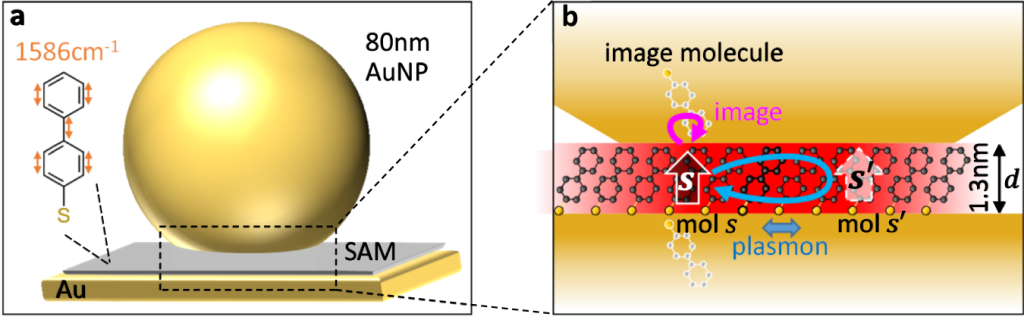
Figure 1 | a Schematic of NPoM constructs, containing 1.3 nm-thick SAM of BPT molecules. b Nanogap supports localized plasmon modes [1]
A tunable laser source is employed to match the plasmonic resonances of the nanocavities, optimizing optomechanical coupling. This poses a change with previous research, where a continuous wave excitation was used. Ultrafast laser pulses are spectrally filtered using a tunable bandpass filter to achieve a 1.5 nm bandwidth, resulting in pulse broadening to 500 femtoseconds. This spectral bandwidth is chosen as a balance between good spectral resolution and sufficient signal strength for clear Raman detection. The pulses are then directed onto the NPoM constructs, and the resulting Raman scattering is collected and analyzed. An Inspire femtosecond Optical Parametric Oscillator (OPO) by Radiantis, pumped by a MaiTai laser from Spectra Physics, was used to perform SERS spectroscopy, due to its spectral flexibility, temporal resolution and ease of integration with Raman spectrometers. The experimental set-up can be seen in Figure 2. Most SERS experiments use Continuous-Wave (CW) excitation, where the spring shifts remain small (as discussed further below). In order to probe these optical spring shifts in a nanocavity, high instantaneous powers are demanded.

Figure 2 | Simplified experimental set-up for SERS with Radiantis Inspire OPO
The analysis in Figure 3 shows that accounting for multiple modes in the nanocavity leads to significant frequency softening due to plasmonic coupling, with enhanced spectral responses at both Stokes and anti-Stokes frequencies—up to ten times stronger than predicted by single-mode models. In the single-mode approach, opposing frequency shifts largely cancel out, resulting in a minimal net shift from the optical spring effect. Moreover, theoretical simulations incorporating these multimodal effects and collective phonon interactions agree with experimental observations of nonlinear Raman spectral behavior in NPoM constructs illuminated by ultrafast laser pulses.

Figure 3 | Origin of optical spring effect in molecular optomechanics [1]
Pulsed Raman scattering from NPoM structures exhibits saturation effects due to extreme local field enhancements and molecular interaction dynamics. Saturation in Raman scattering occurs when the Raman signal intensity ceases to increase proportionally with excitation power. The power was varied from 100 nW to 60 μW, and the saturation effect was studied at three excitation wavelengths: 633, 658 and 700 nm. These wavelengths were selected for gold NPoMs to optimize Raman enhancement while minimizing photodamage.

Figure 4 | Saturation of pulsed Raman scattering. Averaged power-normalized SERS spectra for increasing average power [1]
Figure 4 shows how the Raman signal evolves with varying excitation powers, highlighting the onset of saturation effects as power increases. It is possible to see that the average SERS spectra with increasing intensity exhibits non-linear behaviour. When the power increases, the sharp vibrational peak for low intensities weakens, suggesting energy redistribution into collective modes. This demonstrates that under pulsed laser excitation, the SERS response of NPoM constructs exhibits a saturation behaviour at high laser intensities. This saturation is attributed to the giant optomechanical spring effect within the plasmonic nanocavities, leading to significant softening of molecular bonds and consequent shifts in vibrational frequencies. Understanding this saturation phenomenon is crucial for optimizing SERS applications and for the development of plasmonic devices that leverage strong light-matter interactions.
This research highlights the potential of plasmonic nano- and picocavities to significantly enhance optomechanical interactions, leading to significant modifications in molecular vibrations. By leveraging SERS, these cavities offer a powerful platform for both probing and controlling molecular dynamics, with broad implications for nonlinear optics and chemical reaction control. The findings reveal that the extreme light confinement in plasmonic nano- and picocavities dramatically amplifies optomechanical coupling, resulting in substantial softening of molecular bonds under intense laser illumination. This optomechanical pumping regime induces strong distortions in the Raman vibrational spectrum, producing frequency shifts up to a hundred times larger than those observed in conventional optical cavities.
The femtosecond pulsed lasers were utilized to provide intense, ultrafast excitation, enabling the observation of nonlinear behaviors and significant distortions in the Raman vibrational spectrum. The Inspire OPO enables precise Raman spectroscopy in plasmonic nanocavities, offering tunable excitation and ultrafast pulses to explore optomechanical coupling with exceptional accuracy. In this study, it provided the controlled excitation necessary to investigate the optical spring effect on NPoM constructs, demonstrating how its broad wavelength tunability allows for fine-tuned manipulation of optomechanical interactions at the molecular scale. This capability was key to achieving detailed insights into light-induced bond softening. By facilitating groundbreaking research in plasmonic optomechanics, the Inspire OPO proves to be an indispensable tool for advancing nanophotonics and studying fundamental light-matter interactions with unprecedented control.
To learn more about how femtosecond OPO systems can enhance your research and development efforts, please contact us directly at info@radiantis.com.

- Jakob, L.A., Deacon, W.M., Zhang, Y. et al. Giant optomechanical spring effect in plasmonic nano- and picocavities probed by surface-enhanced Raman scattering. Nat Commun 14, 3291 (2023). https://doi.org/10.1038/s41467-023-38124-1

